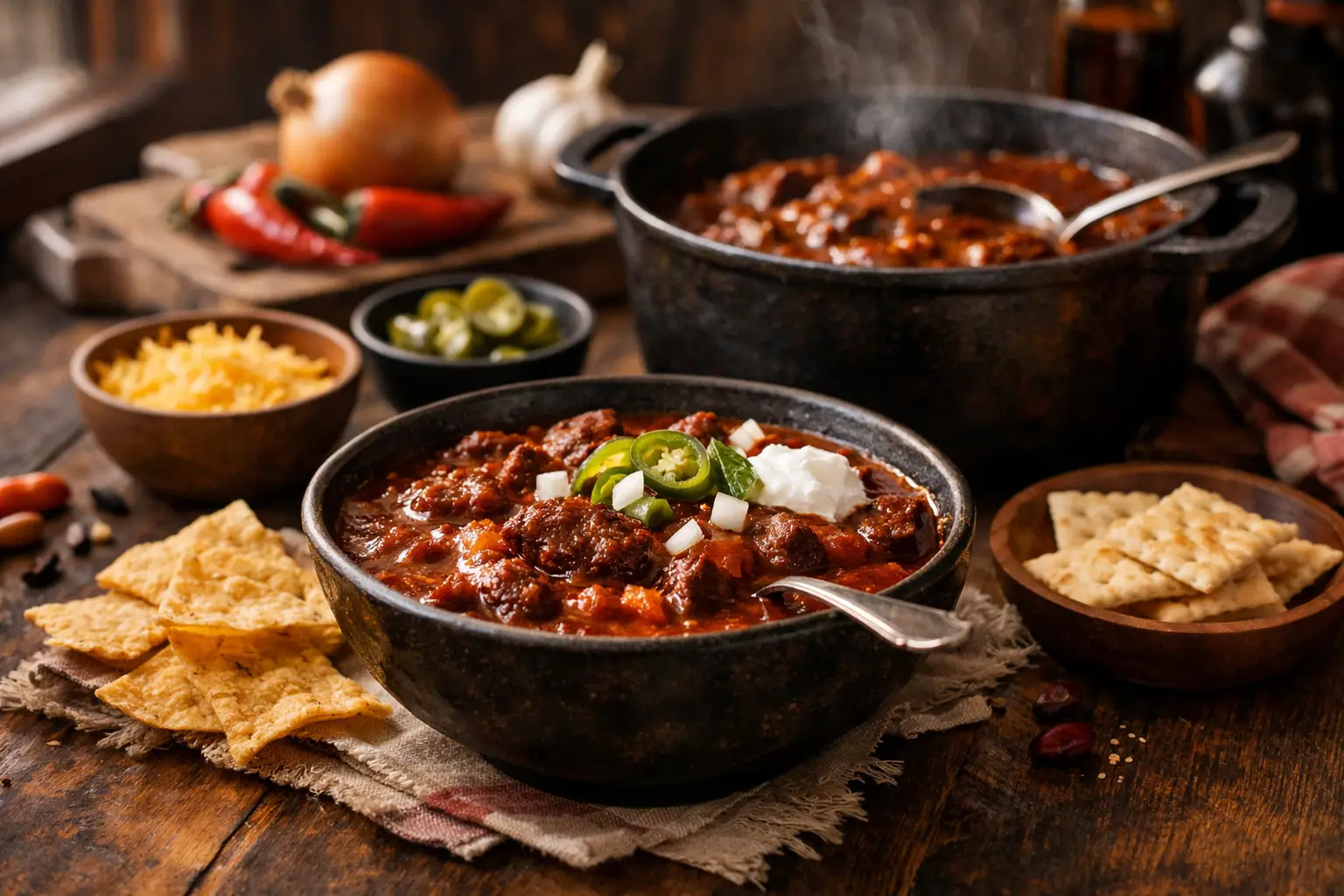
A real Texas red announces itself before the first bite: the deep brick-red color, the savory scent of toasted dried chiles, and hunks of beef tender enough to yield to a spoon. If you are learning how to make Texas red, start with one rule that sets this style apart: the chile is the main event. Not tomatoes. Not a pile of toppings. And, in the traditional Texas camp, definitely not beans.
This is chili with a point of view. Texas red, often called chile con carne, is a slow-cooked beef chili built on a purée of dried chiles. It can be smoky, earthy, fruity, sharp, or seriously fiery depending on the peppers you choose. Every bowl tells a story, and this one begins in the chile aisle.
What Makes Texas Red Different?
Texas red is less like a ground-beef weeknight chili and more like a beef stew powered by a concentrated chile sauce. The texture should be rich but not pasty, with a glossy broth that clings to the meat. You want distinct pieces of beef, not crumbles, and a flavor that develops in layers: toasted chile skin, beefy fond, garlic, cumin, and time.
That does not mean every Texas cook makes it exactly the same way. Some use a little tomato paste for body; others consider even that a detour. Some swear by beer, while others use only stock or water. The common ground is beef plus dried red chiles, cooked low and slow until both become something bigger than their parts.
The Ingredients That Build a Great Bowl
For six generous servings, use 3 pounds boneless beef chuck, cut into 1 1/2-inch cubes. Chuck has enough fat and connective tissue to stay juicy during a long simmer. Brisket can be excellent too, especially if you like a more pronounced beef flavor, but it is leaner in spots and benefits from careful cooking.
For the chile base, gather 5 dried ancho chiles, 4 dried guajillo chiles, and 1 to 3 dried chiles de árbol. Anchos bring raisiny depth and mild warmth. Guajillos bring bright, tangy red-fruit character. Chiles de árbol bring the heat. This is a dependable Texas red lineup, but it is not a law. New Mexico chiles add an earthy, clean flavor; pasillas lean darker and more complex; chipotles can add smoke, though a little goes a long way.
You will also need a large yellow onion, 5 garlic cloves, 2 tablespoons neutral oil or beef tallow, 2 teaspoons ground cumin, 1 teaspoon dried Mexican oregano, 2 cups beef stock, 1 tablespoon masa harina, kosher salt, black pepper, and 1 tablespoon cider vinegar. Keep a bottle of Mexican-style lager or a dark beer nearby if you want to replace part of the stock.
Masa harina is optional, but it earns its spot. A small amount gives the chile a subtle corn aroma and helps the sauce settle into that classic, spoon-coating consistency. It should support the chiles, not turn the pot into gravy.
How to Make Texas Red, Step by Step
Toast and soak the dried chiles
Remove the stems and shake out most of the seeds from the anchos, guajillos, and chiles de árbol. Do not obsess over every seed, but know that leaving a lot behind can create a harsher heat. Heat a dry skillet over medium heat and toast the chiles in batches for about 10 to 20 seconds per side.
This step is quick. You are waking up the oils, not burning the peppers. If the chiles turn black or fill the kitchen with acrid smoke, they will taste bitter. Move toasted chiles to a bowl, cover with very hot water, and soak for 20 to 30 minutes until soft and pliable.
Brown the beef hard
Pat the chuck dry and season it generously with salt and black pepper. Heat the oil or tallow in a heavy Dutch oven over medium-high heat. Brown the beef in batches, leaving space around each piece. Crowding the pot steams the meat, and steamed beef will not give you the dark, savory foundation that makes a Texas red feel like it has been cooking all day.
Transfer browned beef to a plate. Lower the heat slightly, add the onion with a pinch of salt, and cook until softened and golden at the edges, about 7 minutes. Add garlic, cumin, and oregano for the final minute. The pot should smell warm and earthy, not sharply raw.
Blend the red sauce
Drain the soaked chiles, reserving a cup of their soaking liquid. Add the chiles to a blender with the cooked onion mixture, 1 cup beef stock, and about 1/2 cup of the reserved soaking liquid. Blend until very smooth. A powerful blender makes this easy, but any blender works if you give it time.
For a silkier bowl, press the sauce through a fine-mesh strainer. This removes stubborn bits of chile skin and creates a cleaner texture. Skip straining if you prefer a more rustic pot or want to keep the process moving. The flavor will still be fully loaded.
Simmer low and slow
Return the beef and any collected juices to the Dutch oven. Pour in the chile sauce and the remaining stock. Add enough additional water, stock, or beer to barely cover the meat. Bring the pot just to a gentle simmer, then lower the heat, cover partially, and cook for about 2 1/2 to 3 hours.
Check the pot every 30 to 40 minutes. Stir from the bottom so the sauce does not catch, and add a splash of liquid if it is reducing too quickly. The target is not a furious boil. A quiet burble is what turns tough chuck into tender, chile-stained beef without breaking it apart.
When the beef is nearly tender, whisk the masa harina with 3 tablespoons water and stir it into the chili. Simmer uncovered for another 15 to 20 minutes. Finish with cider vinegar, then taste for salt. The vinegar should not make the chili taste sour. It should sharpen the chile flavor the way a final squeeze of lime wakes up a taco.
The Moves That Separate Good Texas Red From Great Texas Red
The biggest mistake is rushing the chile paste. Powdered chili seasoning has its place, but it cannot deliver the rounded, layered flavor of whole dried chiles. Think of dried chiles as the difference between a playlist and a live set: the notes are familiar, but the depth is entirely different.
The second mistake is treating heat as the only measure of chile quality. A blistering bowl can be fun, but Texas red is better when heat has company. Ancho and guajillo provide bass notes and brightness; árbol is the volume knob. Start with one árbol if your table prefers a medium burn, then add more after tasting the blended sauce.
Finally, give the chili a rest. Like many braises, Texas red is often better the next day. Cool it, refrigerate it overnight, and reheat gently. The fat and sauce settle together, the beef absorbs more chile flavor, and the whole pot becomes deeper and more composed.
Beans, Toppings, and the Texas Red Line
Traditional Texas red does not include beans in the pot. That is not a judgment on beans - a great bean chili has its own proud lane. But if the goal is an unmistakable bowl of Texas red, let the beef and chile sauce carry the weight.
Toppings are more flexible. Serve it with diced white onion, shredded cheddar, pickled jalapeños, saltines, or warm flour tortillas. A spoonful of sour cream can calm a hot batch, though some chili purists will keep their bowl strictly red. That is their business. Your business is making a pot you want a second bowl of.
For a cook-off-style presentation, keep the toppings on the side and serve the chili in a simple bowl. For game day, set out the full spread and let people build their own. Texas red has enough personality to stand alone, but it also plays beautifully with a cold beer and a loud table.
The first pot teaches you the method. The next one becomes yours: more guajillo, less árbol, brisket instead of chuck, beer instead of stock. Keep the red sauce at the center, let the beef take its time, and follow the aroma until the kitchen smells like a bowl worth gathering around.