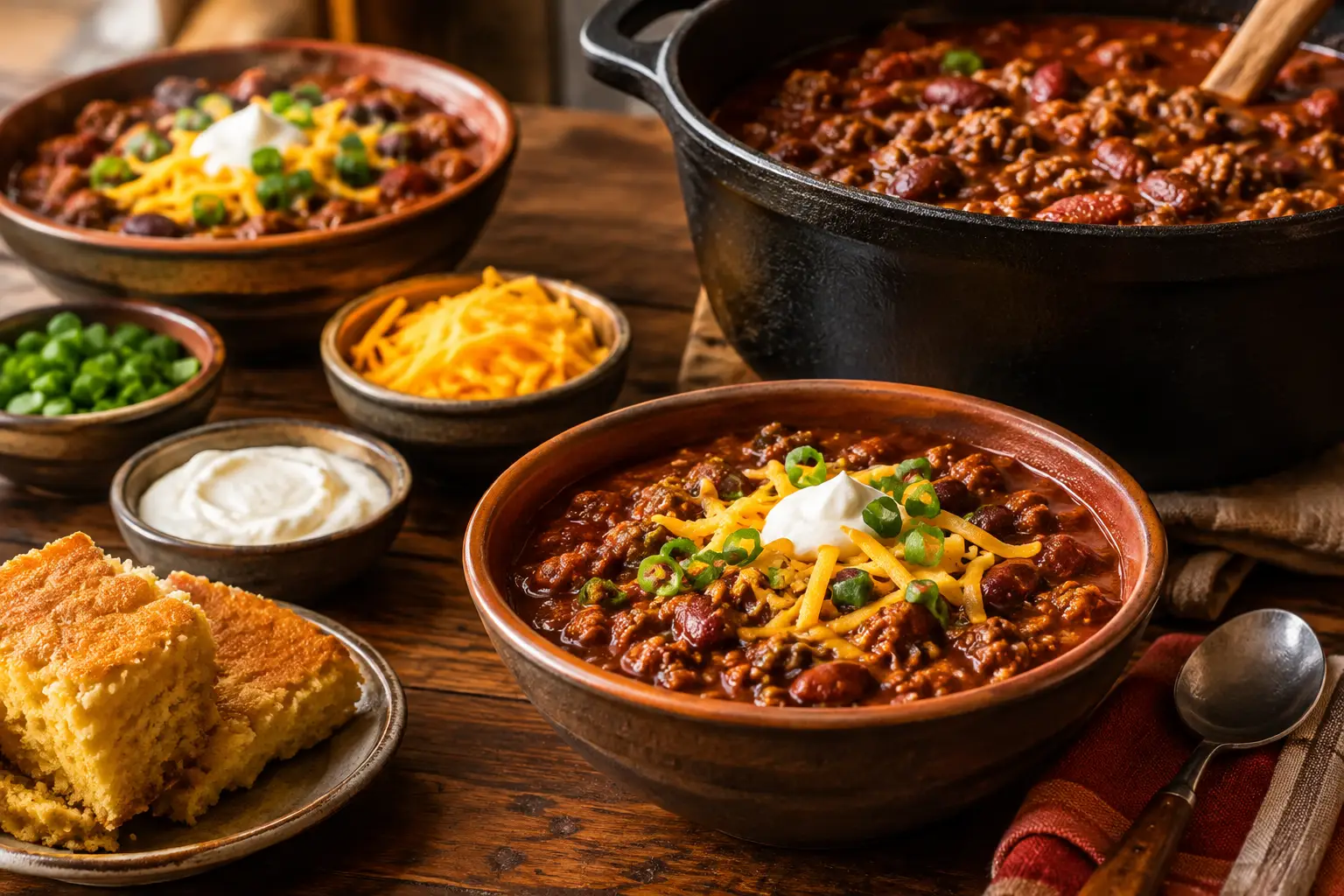
A chili serving size sounds simple until the guest list includes two hungry teenagers, a tray of cornbread, a toppings bar, and that one friend who treats chili like a competitive sport. The right amount is less about a rigid scoop and more about the role chili plays in the meal. Is it the whole main event, a game-day sidekick, or one stop on a potluck buffet? Every bowl tells a story, and every pot needs a plan.
For most meals, plan on 1 1/2 cups of chili per person when it is the main dish. That is generous enough for a satisfying bowl with toppings and a side, without leaving you with a stockpot full of accidental leftovers. Scale up or down from there based on appetite, menu, and chili style.
The standard chili serving size
A typical chili serving size is 1 to 1 1/2 cups per adult. One cup works well for a lighter meal, especially when cornbread, tortilla chips, rice, baked potatoes, or a big salad are part of the spread. Use 1 1/2 cups when chili is the headline act and the only real entree on the table.
For a crowd, that math looks like this:
| Guests | Chili as a main dish | Chili with hearty sides or a buffet | |---|---:|---:| | 4 people | 6 cups, or 1 1/2 quarts | 4 to 5 cups | | 6 people | 9 cups, or just over 2 quarts | 6 to 7 cups | | 8 people | 12 cups, or 3 quarts | 8 to 10 cups | | 12 people | 18 cups, or 4 1/2 quarts | 12 to 15 cups | | 20 people | 30 cups, or 7 1/2 quarts | 20 to 25 cups |
These numbers are a starting point, not a law of the ladle. Chili is famously variable. A bean-heavy turkey chili and a thick Texas Red do not eat exactly the same, even when they fill the same measuring cup.
When to make more than the standard portion
Some occasions call for a bigger pot. Game day is the obvious example. People graze, circle back, and somehow find room for a second bowl between kickoff and halftime. For a long watch party, plan closer to 2 cups per person if chili is the main savory food, particularly if your crowd loves a bold beef chili or a smoky brisket version.
Cold-weather dinners can also push portions upward. A deeply spiced bowl with ground beef, beans, and a blanket of cheddar is comfort food with real staying power, but it also inspires seconds. If you know your guests are chili people, trust that knowledge. Making an extra quart is usually wiser than hoping everyone will politely stop at one bowl.
Potlucks are the opposite case. When the table is packed with mac and cheese, sliders, wings, dips, and desserts, 3/4 to 1 cup per person is generally enough. Chili may be popular, but it is sharing the spotlight. If you are bringing a slow cooker, an 8-quart cooker usually handles a crowd contribution nicely without requiring you to feed the entire block.
Chili style changes the portion math
Regional styles bring their own appetite logic. A classic Texas Red, dense with chile paste and chunks of beef, is rich and concentrated. Many guests will be satisfied with a cup to 1 1/4 cups, especially alongside crackers, onions, and cheese. It is powerful stuff.
Colorado green chili often lands differently. Spoon it over burritos, eggs, fries, or smothered burgers, and the serving size becomes more like a sauce-plus-stew situation. Plan 1/2 to 3/4 cup per person for topping dishes, then make extra because green chili has a way of disappearing by the spoonful.
Cincinnati chili is another wild card. Served over spaghetti, it is not just a bowl meal. For a three-way or five-way, plan around 1 cup of chili per person, plus pasta, cheese, and any other layers your crew demands. A smaller portion of chili still feels substantial once the plate is built.
White chicken chili is often lighter in texture but still filling, particularly when beans, corn, and creamy broth are involved. Stick to 1 1/2 cups as a main-course target. Vegetarian chili can follow the same rule, though a vegetable-forward version with fewer beans and grains may need a little extra volume to satisfy a hungry crowd.
Account for toppings and sides, but do not overcount them
Toppings make a bowl feel abundant. Shredded cheese, sour cream, diced onion, jalapenos, cilantro, avocado, crushed chips, and hot sauce can turn a humble cup of chili into a full-on personal project. They add richness and texture, but they do not replace the chili itself.
A smart rule: if you are serving two substantial sides, such as cornbread and a baked potato bar, you can use the lower end of the portion range. If the only side is a bag of tortilla chips, do not shrink the pot too aggressively.
For topping quantities, estimate about 1/4 cup shredded cheese per guest and 2 tablespoons each of sour cream and chopped onion. Avocado, pickled jalapenos, and cilantro are more preference-driven. Put them out generously, but expect some guests to build a mountain while others keep their bowl clean and classic.
How much chili do kids eat?
For younger kids, start with 1/2 cup. Older kids and teens can easily eat 1 cup or more, especially after practice, a long school day, or an afternoon outside. If heat is part of the recipe, consider serving a milder base chili and letting adults bring the fire with hot sauce, fresh chiles, or a separate spicy batch.
This is one place where a toppings bar earns its keep. Kids can add cheese and chips, adventurous eaters can pile on jalapenos, and nobody has to negotiate over a single heat level. That is good hosting and good chili strategy.
Plan for seconds and leftovers on purpose
The easiest chili serving-size rule is also the most useful: make enough for everyone to have one full bowl, then add 20 percent if you want seconds or leftovers. For eight adults eating chili as dinner, that means making roughly 14 to 15 cups instead of exactly 12.
Leftovers are not a failure of portion planning. Chili improves after a night in the refrigerator, when the spices settle in and the flavors tighten up. Tomorrow's chili can become a baked potato topping, a nacho situation, a chili dog upgrade, or a freezer meal for a night when cooking sounds impossible.
If leftovers are the goal, cool the chili promptly and divide it into shallow containers so it chills efficiently. Smaller portions also make reheating easy: lunch for one, dinner for two, emergency comfort food when the weather turns.
A quick way to choose your pot size
Before you start browning meat or opening beans, ask three questions: How many people are eating? Is chili the main dish? Will people come back for seconds? Multiply your guest count by 1 1/2 cups for a standard dinner, 2 cups for a chili-first party, or 3/4 to 1 cup for a crowded buffet.
Then round up to a pot size that gives you room to stir. A too-full pot is bad energy, especially once the simmer gets lively. A 5- to 6-quart Dutch oven is comfortable for dinner for four to six, while an 8-quart pot is a sweet spot for eight to 12. For a large party, a 10- to 12-quart stockpot gives a serious batch the space it deserves.
The best chili serving size is the one that fits the moment: a cozy bowl on a Tuesday, a loaded five-way on a Sunday, or a slow cooker surrounded by friends watching the game. Make enough to be generous, set out the toppings, and let the bowls tell the rest of the story.